
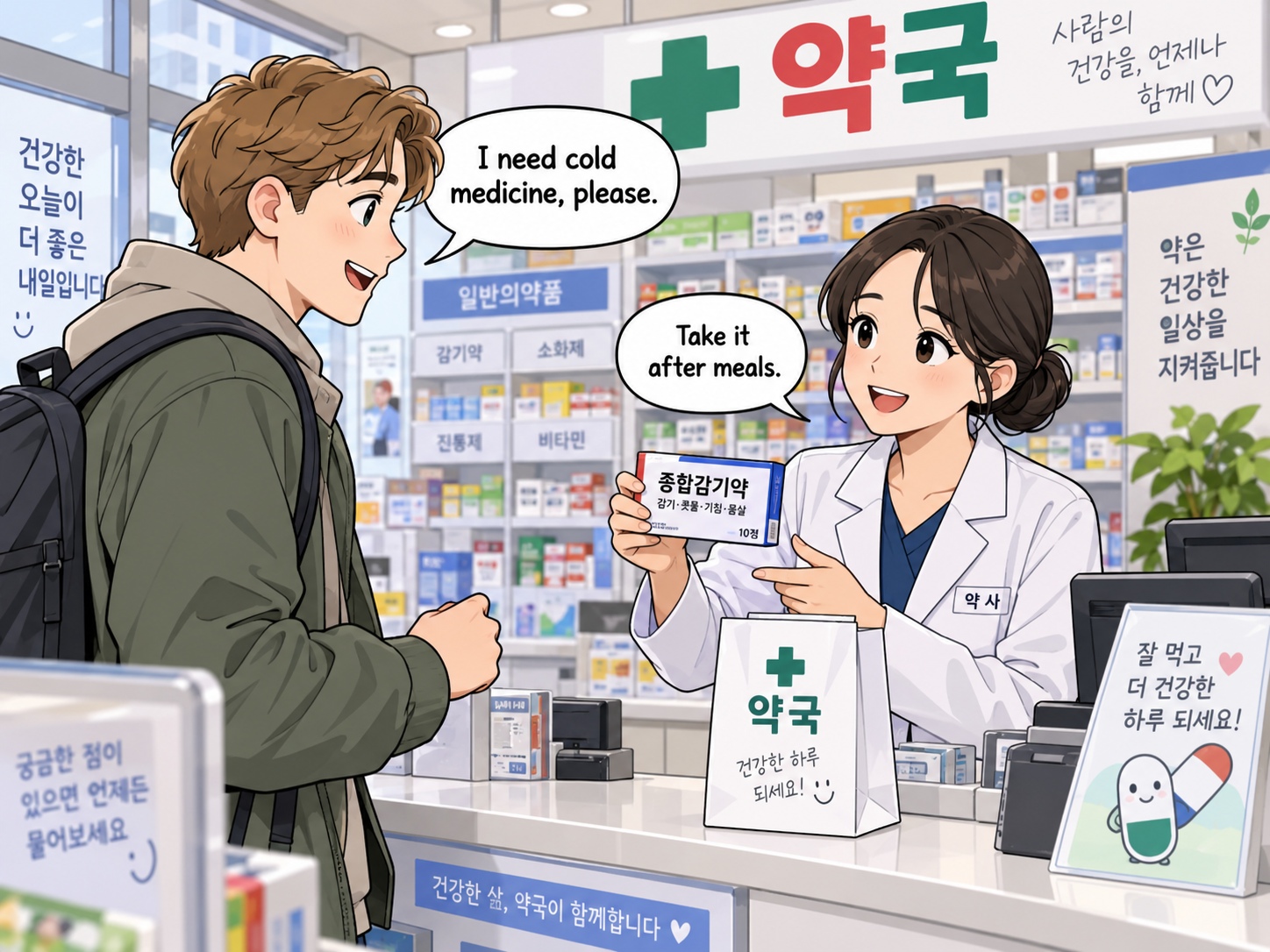
Visiting a pharmacy in Korea is usually simple once you know what to expect.
You do not always need to visit a hospital first.
For common problems such as:
- Headache
- Cold symptoms
- Indigestion
- Diarrhea
- Minor pain
- Allergies
- Small cuts
- Mild skin irritation
a pharmacist may be able to recommend an over-the-counter medicine.
However, some medicines require a prescription from a doctor.
The biggest challenge for foreign newcomers is usually not finding a pharmacy.
It is explaining:
What hurts, how long it has hurt, what other medicines you take, and whether you have allergies.
This guide explains how Korean pharmacies work, what you can buy without a prescription, what to say to the pharmacist, and how to find help when a pharmacy is closed.
The Short Version
If you need medicine in Korea:
- Search 약국 in NAVER Map.
- Bring your prescription if you have one.
- Explain your symptoms to the pharmacist.
- Mention allergies and medicines you already take.
- Ask exactly how and when to take the medicine.
- Keep the medication package and instructions.
- If symptoms are severe or persistent, go to a clinic or hospital instead.
The most useful Korean sentence is:
이 증상에 먹을 약이 필요해요.
I jeungsange meogeul yagi piryohaeyo.
I need medicine for these symptoms.
1. What Is a Pharmacy Called in Korean?
A pharmacy is:
약국
Yakguk
On Korean streets, pharmacies are usually easy to recognize because signs prominently display:
약
or:
약국
Search NAVER Map for:
약국
and you will usually find several nearby.
2. Pharmacy and Drugstore Are Not the Same Thing
In some countries, pharmacies are combined with large drugstores selling:
- Cosmetics
- Snacks
- Household goods
- Medicine
Korean pharmacies are usually more focused on:
- Prescription medicine
- Over-the-counter medicine
- Health products
- Supplements
- Medical supplies
Do not expect every Korean pharmacy to look like a large Western drugstore.
3. Do You Need a Prescription?
Sometimes yes, sometimes no.
Medicines in Korea broadly include:
일반의약품
Ilban-uiyakpum
Over-the-counter medicine
and:
전문의약품
Jeonmun-uiyakpum
Prescription medicine
The Ministry of Food and Drug Safety publishes multilingual information for commonly used over-the-counter drugs, including English-language guidance.
If a medicine requires a prescription, the pharmacist cannot simply sell it to you because you ask for it.
4. What Can You Usually Ask About Without Seeing a Doctor First?
For mild everyday symptoms, you can visit a pharmacy and ask the pharmacist for advice.
Examples include:
- Headache
- Mild cold symptoms
- Sore throat
- Indigestion
- Diarrhea
- Constipation
- Motion sickness
- Minor allergies
- Small wounds
- Minor muscle pain
The pharmacist will decide what is appropriate based on the information you provide.
5. The Pharmacist May Ask You Questions
Do not be surprised if the pharmacist asks:
- What symptoms do you have?
- How long have you had them?
- Do you have a fever?
- Are you taking other medicine?
- Do you have allergies?
- Are you pregnant?
- Do you have another medical condition?
These questions help reduce medication risks.
6. Tell the Pharmacist About Drug Allergies
This is extremely important.
Say:
약 알레르기가 있어요.
Yak allereugiga isseoyo.
I have a medication allergy.
If you know the exact drug or ingredient, show the name.
It is better to show:
- A photo
- Medication package
- Written ingredient name
than rely on memory.
7. Bring a Photo of Medicine You Already Use
If you regularly take medicine from your home country, keep photos of:
- Front of the package
- Active ingredient
- Dosage
The Korea Tourism Organization specifically recommends showing the pharmacist a photo of the medicine you need if communication is difficult.
Brand names vary between countries.
The active ingredient is often more useful than the brand name.
8. Use Papago if Necessary
If you cannot explain your symptoms in Korean:
- Open Papago.
- Type your symptom in English.
- Translate it into Korean.
- Show the screen to the pharmacist.
Korea Tourism Organization explicitly recommends translation apps as a practical way for foreign visitors to communicate at pharmacies.
For simple symptoms, this often works well.
9. Important: Do Not Hide Medical Information Because You Are Embarrassed
Tell the pharmacist if relevant:
- You are pregnant
- You are breastfeeding
- You have high blood pressure
- You have diabetes
- You have liver or kidney problems
- You take prescription medicine
Even common cold medicine can interact with other drugs or medical conditions.
10. Common Symptom Words
| Korean | Meaning |
|---|---|
| 두통 | Headache |
| 열 | Fever |
| 감기 | Cold |
| 기침 | Cough |
| 콧물 | Runny nose |
| 코막힘 | Stuffy nose |
| 목이 아파요 | Sore throat |
| 배가 아파요 | Stomachache |
| 소화불량 | Indigestion |
| 설사 | Diarrhea |
| 변비 | Constipation |
| 알레르기 | Allergy |
| 어지러워요 | Dizzy |
| 몸살 | Body aches / flu-like aches |
| 근육통 | Muscle pain |
| 생리통 | Menstrual cramps |
| 멀미 | Motion sickness |
11. “My Head Hurts”
Say:
머리가 아파요.
Meoriga apayo.
My head hurts.
Or:
두통이 있어요.
Dutongi isseoyo.
I have a headache.
12. “My Throat Hurts”
목이 아파요.
Mogi apayo.
My throat hurts.
If you also have a cough:
기침도 해요.
Gichimdo haeyo.
I also have a cough.
13. “I Have a Fever”
열이 있어요.
Yeori isseoyo.
I have a fever.
If you know the temperature:
38도예요.
Sansip-pal doyeyo.
It is 38°C.
14. “I Have Diarrhea”
설사를 해요.
Seolsareul haeyo.
I have diarrhea.
You can add:
어제부터요.
Eojebuteoyo.
Since yesterday.
15. “My Stomach Hurts”
배가 아파요.
Baega apayo.
This phrase is useful but vague.
Try to explain whether you mean:
- Stomach cramps
- Indigestion
- Nausea
- Diarrhea
The pharmacist may ask follow-up questions.
16. Indigestion
A common Korean word is:
소화불량
Sohwa-bullyang
You can say:
소화가 잘 안 돼요.
Sohwaga jal an dwaeyo.
I am having trouble digesting food.
17. Allergies
For seasonal or environmental allergies:
알레르기 증상이 있어요.
Allereugi jeungsangi isseoyo.
I have allergy symptoms.
If your nose is the main problem:
콧물하고 재채기가 심해요.
Konmulhago jaechaegiga simhaeyo.
My runny nose and sneezing are bad.
18. Motion Sickness Medicine
Ask:
멀미약 있어요?
Meollimiyak isseoyo?
Do you have motion sickness medicine?
This can be useful before:
- Bus trips
- Ferries
- Long car trips
Korea Tourism Organization notes that pharmacies, including airport pharmacies, commonly carry travel-related medicines such as motion-sickness products.
19. Painkillers
You can ask:
진통제 있어요?
Jintongje isseoyo?
Do you have a painkiller?
But do not stop there.
Tell the pharmacist:
- Where the pain is
- Whether you take other medicines
- Whether you have stomach problems or allergies
so they can recommend an appropriate option.
20. Cold Medicine
Ask:
감기약이 필요해요.
Gamgiyagi piryohaeyo.
I need cold medicine.
You may receive several tablets or packets depending on your symptoms.
Make sure you understand which medicine is for what.
21. Medicine May Be Packaged Differently Than You Expect
Korean pharmacies may sometimes provide medicines in individual dose packets, especially after a prescription.
You might receive small packages marked:
- 아침
- 점심
- 저녁
meaning:
- Morning
- Lunch
- Evening
This makes it easier to take several prescribed medicines together at the correct time.
22. How to Ask “How Do I Take This?”
Say:
이 약은 어떻게 먹어요?
I yageun eotteoke meogeoyo?
How do I take this medicine?
This is one of the most important phrases in the entire guide.
23. Common Dosage Instructions
하루에 한 번
Harue han beon
Once a day
하루에 두 번
Harue du beon
Twice a day
하루에 세 번
Harue se beon
Three times a day
한 번에 한 알
Han beone han al
One tablet at a time
24. Before or After Meals
You may hear:
식전
Shikjeon
Before a meal
식후
Shikhu
After a meal
One example you may see on a label is:
식후 30분
Shikhu samsip bun
30 minutes after a meal
Confirm the timing for your own medicine with the pharmacist. The phrases above are examples, including the one in the illustration.
25. “Can I Take This on an Empty Stomach?”
공복에 먹어도 돼요?
Gongboge meogeodo dwaeyo?
Can I take this on an empty stomach?
Useful if your eating schedule is irregular.
26. “Will This Make Me Sleepy?”
This is especially important for:
- Allergy medicine
- Cold medicine
- Certain cough medicines
Ask:
이 약 먹으면 졸려요?
I yak meogeumyeon jollyeoyo?
Will this medicine make me sleepy?
If you need to drive or work, ask before taking it.
27. Alcohol and Medicine
Ask:
술 마셔도 돼요?
Sul masyeodo dwaeyo?
Can I drink alcohol while taking this?
Do not assume that because a medicine is sold over the counter it is safe with alcohol.
28. Ask About Interactions
If you already take medicine, say:
이 약을 먹고 있어요. 같이 먹어도 돼요?
I yageul meokgo isseoyo. Gachi meogeodo dwaeyo?
I am taking this medicine. Can I take them together?
Show the medication to the pharmacist if possible.
29. Prescription Medicine
If a doctor gives you a prescription:
처방전
Cheobangjeon
take it to a pharmacy.
You can say:
처방전이 있어요.
Cheobangjeoni isseoyo.
I have a prescription.
30. Pharmacies Are Often Located Near Clinics and Hospitals
In Korea, you will often see several pharmacies near:
- Clinics
- Hospitals
- Medical buildings
This is convenient because after seeing a doctor, you can take the prescription to a nearby pharmacy.
You usually do not need to return to the hospital to collect the medicine.
31. Prescription and Pharmacy Payment Are Usually Separate
In a typical outpatient visit:
- Pay the clinic or hospital.
- Receive the prescription.
- Visit a pharmacy.
- Pay the pharmacy separately.
Newcomers sometimes assume medicine is included in the clinic payment.
Often it is not.
32. Do You Need Your Residence Card?
For an ordinary over-the-counter purchase, you generally do not need to present a Residence Card simply to ask for common medicine.
For prescription dispensing or insurance-related processing, identity and insurance information can be relevant.
If you are a resident using Korean National Health Insurance, bring the identification you normally use for medical care.
33. What About Foreign Tourists?
Short-term visitors can also use Korean pharmacies.
Korea Tourism Organization specifically provides pharmacy guidance for international visitors and notes that pharmacies can recommend local alternatives when an identical foreign medicine is unavailable.
If you need a complex or prescription medicine, however, you may need to see a doctor first.
34. A Foreign Prescription May Not Automatically Work the Same Way
If you arrive with a prescription from another country, do not assume a Korean pharmacy can simply dispense the same prescription medicine.
For ongoing or specialized medication, bring:
- Medical records
- Drug names
- Active ingredients
- A doctor's letter if available
Korea Tourism Organization recommends carrying medical records and an English prescription for more complex medication needs, especially when traveling.
You may still need to see a Korean doctor.
35. Bring Enough Regular Medication When Possible
If you rely on a specific medication, do not assume the exact brand is sold in Korea.
Before moving:
- Check whether the active ingredient exists in Korea
- Bring appropriate documentation
- Bring a reasonable supply where legally permitted
For controlled or specially regulated medication, check Korean import rules before traveling.
36. Not Every Medicine Is Sold in Convenience Stores
Korean convenience stores can sell certain limited categories of emergency OTC medicine under specific rules, but a convenience store is not a substitute for a pharmacy.
If you have a choice:
Go to a pharmacy for medicine advice.
A pharmacist can ask about symptoms and recommend an appropriate product.
37. Pharmacy Opening Hours Vary
Do not assume pharmacies are open 24 hours.
Some close:
- In the evening
- On Sundays
- On public holidays
Check current hours and call the pharmacy ahead of a special trip.
38. How to Find an Open Pharmacy at Night
Search NAVER Map for:
약국
then check:
- Current opening status
- Closing time
- Recent information
Useful searches include:
야간 약국
Night pharmacy
or:
24시 약국
24-hour pharmacy
But verify the hours before traveling.
39. Pharmacies Near Airports
If you become sick while traveling, Korean airports also have pharmacies.
Korea Tourism Organization notes that both Gimpo and Incheon airports have pharmacy locations for travelers, with multiple pharmacies operating in Incheon Airport terminals.
Opening hours still depend on the specific location.
40. When a Pharmacy Is Not Enough
For a medical emergency, call 119 for an ambulance. Examples of emergency signs include:
- Severe difficulty breathing
- Severe chest pain
- Loss of consciousness
- Serious injury
- Heavy bleeding
- Severe allergic reaction
- Very high fever with concerning symptoms
- Symptoms that are rapidly worsening
For symptoms that persist or worsen without an immediate emergency, seek medical care at a clinic or hospital.
41. Persistent Symptoms Need Medical Evaluation
If you keep buying OTC medicine but the problem does not improve, see a doctor.
Examples:
- Fever that continues
- Persistent abdominal pain
- Recurrent vomiting
- Severe diarrhea
- Persistent cough
- Skin condition spreading quickly
Do not repeatedly treat symptoms without finding the cause.
42. Pharmacists Can Help You Decide Whether to See a Doctor
You can ask:
병원에 가야 할까요?
Byeongwone gaya halkkayo?
Should I go to a hospital or clinic?
The pharmacist may tell you that your symptoms need medical evaluation.
This can be especially helpful when you are unfamiliar with Korea's healthcare system.
43. Cards Are Commonly Accepted
Many Korean pharmacies accept card payment.
Current VisitKorea listings for pharmacies in Seoul commonly show card payment as accepted.
Still, having a backup payment method is useful if you are newly arrived.
44. Do Not Choose Medicine Only by Packaging
Korean medicine packaging may look unfamiliar.
Do not choose a medicine because:
- The box looks similar
- The color resembles a product from home
- A friend said it is strong
Ask the pharmacist about:
- Active ingredient
- Intended use
- Dosage
- Warnings
45. Supplements Are Not the Same as Medicine
Pharmacies also sell:
- Vitamins
- Probiotics
- Nutritional supplements
- Health products
Do not confuse these with medicine prescribed or recommended for a medical condition.
Korea Tourism Organization notes that Korean pharmacists may also advise customers about supplements and general health products.
46. Useful Pharmacy Words
| Korean | Meaning |
|---|---|
| 약국 | Pharmacy |
| 약 | Medicine |
| 약사 | Pharmacist |
| 처방전 | Prescription |
| 일반의약품 | Over-the-counter medicine |
| 전문의약품 | Prescription medicine |
| 진통제 | Painkiller |
| 감기약 | Cold medicine |
| 소화제 | Digestive medicine |
| 지사제 | Anti-diarrheal medicine |
| 변비약 | Constipation medicine |
| 알레르기약 | Allergy medicine |
| 연고 | Ointment |
| 밴드 | Adhesive bandage |
| 복용 | Taking medicine |
| 식전 | Before meals |
| 식후 | After meals |
| 공복 | Empty stomach |
| 부작용 | Side effect |
| 알레르기 | Allergy |
47. Useful Korean Phrases
I need medicine for a cold.
감기약이 필요해요.
Gamgiyagi piryohaeyo.
I have a headache.
두통이 있어요.
Dutongi isseoyo.
My stomach hurts.
배가 아파요.
Baega apayo.
I have diarrhea.
설사를 해요.
Seolsareul haeyo.
I have allergies.
알레르기가 있어요.
Allereugiga isseoyo.
How do I take this?
이 약은 어떻게 먹어요?
I yageun eotteoke meogeoyo?
How many times a day?
하루에 몇 번 먹어요?
Harue myeot beon meogeoyo?
Before or after meals?
식전에 먹어요, 식후에 먹어요?
Shikjeone meogeoyo, shikhue meogeoyo?
Will it make me sleepy?
이 약 먹으면 졸려요?
I yak meogeumyeon jollyeoyo?
Can I take this with my other medicine?
이 약이랑 같이 먹어도 돼요?
I yagirang gachi meogeodo dwaeyo?
Should I go to a clinic?
병원에 가야 할까요?
Byeongwone gaya halkkayo?
48. A Simple Pharmacy Conversation
You:
목이 아프고 기침을 해요.
Mogi apeugo gichimeul haeyo.
My throat hurts and I have a cough.
Pharmacist:
They may ask about:
- Fever
- Duration
- Other medicine
You:
열은 없어요. 이틀 전부터 아팠어요.
Yeoreun eopseoyo. Iteul jeonbuteo apatseoyo.
I don't have a fever. It started two days ago.
Then ask:
이 약은 어떻게 먹어요?
How do I take this?
That is enough to handle many simple pharmacy visits.
49. What to Bring
For a simple OTC visit:
- Phone
- Translation app
- Payment card
- List/photo of current medication if relevant
For prescription medicine:
- Prescription
- Identification if needed
- Insurance information if relevant
For complicated medication needs:
- Medical record
- Ingredient information
- Previous prescription or doctor's letter
50. Common Mistakes Foreign Newcomers Make
Asking Only for a Brand Name From Home
Show the active ingredient too.
Not Mentioning Other Medicines
Interactions matter.
Forgetting to Mention Allergies
Always tell the pharmacist.
Assuming Every Drug Is OTC
Some require a prescription.
Not Asking How to Take the Medicine
Confirm dosage and timing.
Assuming Every Pharmacy Is Open Late
Check opening hours.
Continuing OTC Medicine for Too Long
See a doctor if symptoms persist or worsen.
Using Translation Apps Without Checking Critical Details
For dosage and warnings, confirm directly with the pharmacist.
51. First Pharmacy Visit Checklist
- Search
약국in NAVER Map - Check opening hours
- Write down my symptoms
- Know when the symptoms started
- Bring a list/photo of medicines I already take
- Mention allergies
- Ask how often to take the medicine
- Ask whether to take it before or after meals
- Ask whether it causes drowsiness
- Keep the packaging and instructions
FAQ
Can foreigners buy medicine at a Korean pharmacy?
Yes. Foreign visitors and residents can visit Korean pharmacies, and pharmacists can recommend suitable over-the-counter medicines for appropriate minor symptoms. Korea Tourism Organization specifically provides pharmacy guidance for international visitors.
Do I need a prescription for every medicine?
No. Korea has both over-the-counter medicines and prescription-only medicines. The Ministry of Food and Drug Safety provides multilingual consumer information for commonly used OTC medicines.
Can I show the pharmacist a photo of my medicine?
Yes. This is specifically recommended by Korea Tourism Organization when language or brand-name differences make communication difficult.
Can I use Papago at the pharmacy?
Yes. A translation app can be very useful for explaining symptoms, allergies and the medicine you are looking for.
Are pharmacies open on Sundays?
Some are, some are not. Opening hours vary significantly by location, so check the specific pharmacy before going.
Can I buy my foreign prescription medicine in Korea?
Not necessarily. Availability, brand names and prescription requirements can differ. Bring the active ingredient, medical records and relevant prescriptions, and be prepared to see a Korean doctor if necessary.
What should I do in a medical emergency?
Call 119 or go to an emergency medical facility. A pharmacy is not appropriate for a serious emergency.
Final Advice
A Korean pharmacy is one of the easiest parts of the healthcare system for a newcomer to use.
You do not need perfect Korean.
For most simple situations, you only need to communicate four things:
What symptom do I have?
How long have I had it?
What medicine am I already taking?
Do I have any allergies?
Then ask:
이 약은 어떻게 먹어요?
How do I take this medicine?
If you cannot explain everything verbally, use Papago and show photos of medicines or ingredients.
And remember the limit of pharmacy care.
For a minor headache or mild cold, a pharmacist may be exactly the right person to ask.
For severe, persistent or worsening symptoms, move to the next level of care:
clinic or hospital
Learning this distinction makes healthcare in Korea much less intimidating.
Related KoreaVibes Guides
- First Week in Korea: What Foreigners Should Set Up First
- Essential Korean Apps for Foreigners Living in Korea
- How to Get a SIM Card or eSIM in Korea as a Foreigner