
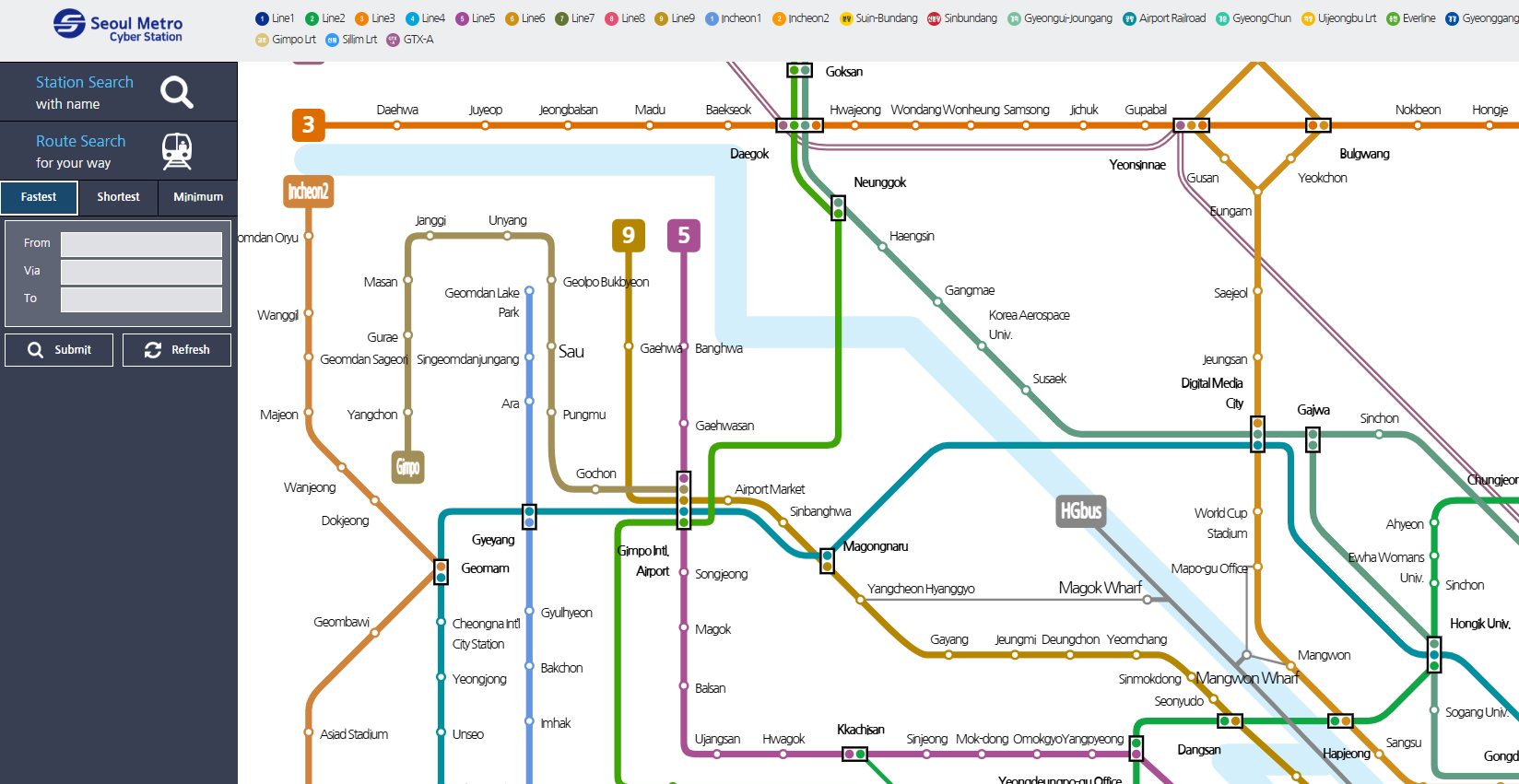
Seoul's subway system is one of the easiest ways to travel between concert venues, entertainment company areas, pop-up stores, album shops, birthday cafes, and popular K-pop neighborhoods. It is clean, frequent, and connected to most places a first-time fan is likely to visit.
However, a subway trip in Seoul involves more than choosing a station. Large stations may have several lines, long transfer corridors, and more than ten exits. A place that looks close on a map may still require a long underground walk.
This guide explains how international K-pop fans can use the Seoul subway more confidently and avoid common mistakes on concert days, pop-up reservation days, and agency-area trips.
1. Use a transportation card when possible
A prepaid transportation card is usually the most convenient option for visitors who plan to use subways and buses several times. Common transportation cards include T-money and other compatible prepaid cards. They can be used by tapping the card at subway gates and on buses. Learn how to buy, recharge and use a Korean transportation card in our T-money Card Guide for Foreign Visitors.
The purchase price of the physical card is separate from the transportation balance. After buying the card, make sure it has enough money loaded before beginning a long trip. Transportation cards are commonly available at convenience stores and transportation facilities, although availability and card designs vary by location.
How to use the card
- Find the subway gate with a green arrow.
- Tap the card on the reader and wait for the gate to open.
- Check the remaining balance shown on the screen.
- Follow signs for the correct exit at your destination.
- Tap the same card again at the exit gate.
Each passenger should use a separate card. Do not pass one card back to another traveler after entering.
2. Keep some Korean won as a backup
Foreign credit and debit cards are widely accepted in Korea, but transportation payment systems can still be confusing. Some newer ticket machines may accept internationally issued cards or supported mobile payments for certain products, but acceptance can depend on the station, machine, card network, and ticket type.
A regular transportation card may also require a different charging method from a single-journey ticket or short-term tourist pass. The safest plan is to carry one transportation card, a small amount of Korean cash, one international payment card, and one backup payment method. Do not wait until the balance is almost empty before trying to recharge it, especially on a concert day.
3. Single-journey tickets are available
Visitors who do not have a transportation card can buy a single-journey subway ticket at a station. Ticket machines usually provide multiple language options. Select your destination, pay the required fare and deposit, and collect the card.
After arriving, return the single-journey card at a deposit refund machine to receive the refundable deposit. A single-journey ticket is less convenient for fans making several stops because a new ticket must be purchased for each trip. It is also intended for subway travel rather than ordinary bus transfers. For a full day of fan activities, a reusable transportation card is normally easier.
4. Consider a short-term Climate Card
Seoul also offers short-term versions of the Climate Card for visitors planning frequent transportation within its covered service area. The pass can be useful when your itinerary includes several subway or bus rides each day.
However, it does not cover every railway, airport service, private line, or route outside the designated area. Before buying one, compare your itinerary with the current coverage map. Do not choose a pass only because it offers unlimited rides. Choose it after checking whether your actual routes are covered.
| Itinerary style | Climate Card fit | Why |
|---|---|---|
| Seoul-only fan route | May be useful | Several subway and bus rides can add up. |
| Airport-heavy route | Check carefully | Airport services may not be included. |
| Outside-Seoul day trips | Often limited | Coverage may stop before your destination. |
| One or two subway rides | Usually unnecessary | A regular card or ticket is simpler. |
5. Use NAVER Map to check the station and exit
Knowing the nearest station is not enough. The station exit can make a major difference. For subway and walking directions in Seoul, NAVER Map is generally more useful than Google Maps. It provides detailed subway routes, transfer information, station exit numbers, bus routes, and walking directions.
NAVER Map supports an English interface. KakaoMap is also useful for checking detailed Korean transportation and local routes, although some information may still appear in Korean. Google Maps can help with general location searches and international reviews, but it may not provide the same level of detail for station exits, local walking routes, or recently updated places in Korea.
Large Seoul stations may have many exits located on different sides of a road, shopping complex, park, or neighborhood. Choosing the wrong exit can add a long walk and may require crossing a major intersection.
Before boarding, use NAVER Map or KakaoMap to save the Korean and English station name, subway line number and color, direction of travel, transfer station, final exit number, the walking route after leaving the station, and the return route to your hotel.
For example, do not save only "Olympic Park Station." Also save the subway line, the recommended exit, and the walking route to the exact concert venue or entrance. A screenshot is useful when mobile service is slow or the station is crowded.
6. Understand the direction of travel
Seoul subway platforms may identify direction by the next station, a major station farther along the line, an inner-circle or outer-circle direction, a final destination, or a branch-line destination. Do not rely only on the line color. The same line travels in two directions, and some lines divide into branches.
Before passing through the gate, check the name of the next station shown in your map app. Compare it with the station signs on the platform. When uncertain, show your destination on your phone and ask, "이쪽 방향 맞아요?" meaning "Is this the right direction?"
7. Transfers can take longer than expected
A transfer does not always mean walking across one platform. At large stations, transferring may involve several escalators, long underground corridors, multiple levels, crowded moving walkways, separate platform directions, or a special transfer route.
A route that shows a short travel time may still feel long when carrying merchandise, luggage, banners, or concert supplies. Whenever possible, choose a route with fewer transfers rather than simply choosing the route with the shortest estimated time. One simple transfer is often easier than two complicated transfers, even when it takes a few minutes longer.
8. Do not confuse the station with the venue
Major K-pop venues are not always directly connected to the nearest station. After arriving at the station, you may still need to find the correct exit, walk through a park, cross a large road, follow temporary event signs, walk around the outside of a stadium, or find a specific gate or ticket booth.
For concert days, save both the station and the exact venue entrance. "KSPO Dome" and "Olympic Park Station" are not the same destination. The correct gate for ticket pickup may also be different from the audience entrance.
9. Leave early for concerts and reservations
Ordinary subway travel becomes more difficult when thousands of fans are moving toward the same venue. Before a concert, stations may become crowded with people buying food, collecting tickets, meeting friends, and searching for entrances. After the show, platforms and station entrances may be temporarily controlled for safety.
Arriving early gives you time to find the correct venue, collect or verify a ticket, buy merchandise, eat before entering, use the restroom, charge your phone, find your seating entrance, and handle unexpected identity checks. For a timed pop-up reservation, plan to arrive in the neighborhood at least 30 minutes early.
10. Plan the trip home before the event
Do not wait until a concert ends to decide how to return to your hotel. Before entering the venue, check the final subway route, approximate last-train time, alternative subway lines, nearby bus routes, a safe taxi pickup area, and the walking distance to another station.
Concert ending times can change, and leaving the venue may take longer than expected. Even after the final song, you may need time to exit your section, walk around the venue, reach the station, and wait outside a controlled entrance. Take a screenshot of the return route before the concert begins.
11. Avoid the busiest cars when possible
Fans often gather near the cars closest to the main station exits and transfer escalators. These cars may save a few minutes after arrival, but they can also become extremely crowded. When you have luggage, shopping bags, or fragile merchandise, moving toward a less crowded part of the platform may be more comfortable.
During weekday commuting periods, the subway is busiest in the morning and evening. Large event days can also create heavy crowds outside normal rush hours. Keep bags close to your body and avoid blocking doors or aisles.
12. Follow basic subway etiquette
- Stand to the side of the doors and let passengers leave first.
- Move farther inside the train when possible.
- Keep phone calls quiet and use headphones for music or videos.
- Be careful with priority seats for elderly, pregnant, disabled, or injured passengers.
- Keep merchandise, slogans, albums, and shopping bags out of seats and walkways.
13. What to do if you miss your stop
Missing a station is usually easy to fix. Leave the train at the next station, follow signs to the platform going in the opposite direction, and return one stop. However, platform layouts vary. At some stations, the opposite platform is across the tracks. At others, you may need to use stairs or follow a longer passage.
Do not pass through an exit gate unless your map shows that it is necessary. If you need help, ask "반대편으로 어떻게 가요?" meaning "How do I reach the opposite platform?"
14. What to do if the gate does not open
A gate may not open because of insufficient balance, an incomplete previous trip, tapping too quickly, using the wrong card, a card-reading error, or entering or leaving through the wrong gate. Do not repeatedly force the card against the reader.
Look for the station office or staff assistance gate and show your card. Staff can usually check the problem. You can also show the error message displayed on the gate.
15. Use station lockers carefully
Some subway stations and nearby facilities have lockers that can be useful before a concert or shopping trip. However, availability, size, payment method, and operating rules vary. Lockers near major venues may fill quickly on event days.
Before storing a bag, confirm the facility's closing time, save the exact locker location, take a photo of the locker number, check the payment or retrieval method, and avoid leaving essential identification or tickets inside.
Useful Korean subway phrases
| Korean | Pronunciation | Meaning |
|---|---|---|
| 이쪽 방향 맞아요? | Ijjeok banghyang majayo? | Is this the right direction? |
| 이 역에서 갈아타요? | I yeogeseo garatayo? | Do I transfer at this station? |
| 몇 번 출구예요? | Myeot beon chulguyeyo? | Which exit is it? |
| 반대편으로 어떻게 가요? | Bandaepyeoneuro eotteoke gayo? | How do I reach the opposite platform? |
| 카드가 안 돼요. | Kadeuga an dwaeyo. | The card is not working. |
| 충전해 주세요. | Chungjeonhae juseyo. | Please recharge it. |
| 이 열차 맞아요? | I yeolcha majayo? | Is this the correct train? |
| 막차가 몇 시예요? | Makchaga myeot siyeyo? | What time is the last train? |
Common mistakes K-pop fans make
Choosing the closest-looking station
The nearest station on a map may not provide the easiest walking route or venue entrance.
Forgetting the exit number
Leaving through the wrong exit can add considerable walking time.
Planning transfers too tightly
A transfer shown as a few minutes may take longer in a crowded or unfamiliar station.
Arriving at the venue exactly on time
The station, venue entrance, ticket booth, and seating gate may all be in different places.
Depending on one payment method
A foreign card may not work with every ticket machine or transportation product.
Forgetting the return route
Crowds and service ending times can make the trip home more complicated than the trip to the event.
Subway planning checklist
- The destination's Korean name
- The correct subway station
- The subway line and direction
- Every transfer station
- The final exit number
- The walking route to the venue
- Your transportation card balance
- The return route and approximate final-train schedule
- A backup route or taxi pickup point
FAQ
Is the Seoul subway difficult for first-time visitors?
The system is large, but station signs usually include English. The most difficult parts are choosing the correct direction, making long transfers, and finding the right exit.
Which map app should I use for subway travel in Seoul?
NAVER Map is usually the best primary navigation app for international visitors in Seoul. It provides detailed subway routes, station exits, bus information, walking directions, and local place listings, and it supports an English interface.
KakaoMap is also useful as a backup for checking detailed local routes and transportation information. Google Maps can help with general locations and international reviews, but it should not be your only navigation app in Korea.
Can I use a foreign credit card directly at the subway gate?
Do not assume that every overseas card can be tapped directly at every subway gate. Seoul is expanding international payment options, but availability depends on the system and service. Prepare a transportation card or valid ticket unless the specific service confirms direct payment.
Is a transportation card better than single tickets?
For visitors taking several subway or bus trips, a reusable transportation card is generally more convenient. A single-journey ticket can work for occasional subway use.
How early should I leave for a K-pop concert?
Leave enough time for the subway ride, transfers, station exit, walking route, ticket collection, security procedures, and venue navigation. For a large event, arriving in the area several hours before the performance can make the day less stressful.
Can I take the subway after a concert?
Usually, but you should check the final service time and expected crowd conditions in advance. The process of leaving a large venue can take longer than expected.
Final advice
The Seoul subway becomes much easier when you plan beyond the station name. For a smooth K-pop trip, remember three details: the direction, the exit number, and the route home. Save them before leaving, carry a payment backup, and allow more time than the map's basic train estimate.
A few extra minutes of preparation can prevent a missed reservation, a stressful concert arrival, or a long walk in the wrong direction.
Related KoreaVibes guides
- First-time Seoul guide for K-pop fans
- K-pop Concert Day in Korea
- How to Take a Taxi in Korea as a Foreigner
- How to get from Incheon Airport to Seoul
- T-money Card Guide for Foreign Visitors
- How to Pay in Korea as a Foreigner
- How Korean concert ticketing works for foreigners
- How K-pop pop-up stores work in Seoul
- Essential Korean phrases for fan events