
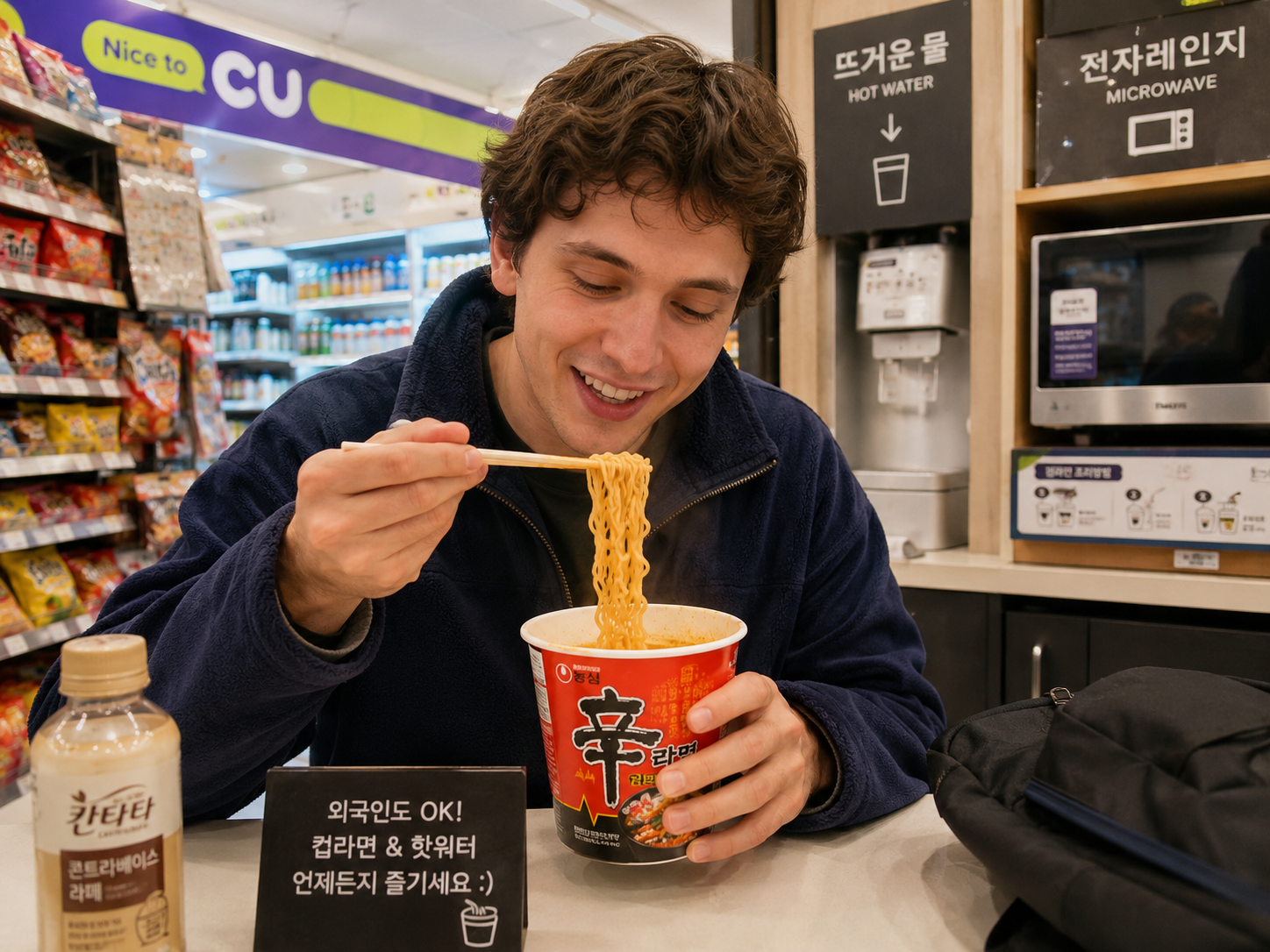
If you are new to Korea, convenience stores will probably become part of your daily life much faster than you expect. At first, you may think of them as places to buy drinks, snacks and instant noodles. In practice, they can also work like a small neighborhood service counter.
Depending on the branch, a Korean convenience store may help with meals, transportation card top-ups, parcel shipping, package pickup, ATMs, bill payments, SIM products, printing and other everyday services. The key phrase is depending on the branch. Not every store offers every service.
The short version
| Need | What convenience stores can help with | What to check |
|---|---|---|
| Food | Lunch boxes, gimbap, cup noodles, snacks, drinks. | Expiration time and heating instructions. |
| Transport | T-money or transportation-card purchase/top-up at many stores. | Payment method for top-up may differ from normal shopping. |
| Parcels | Domestic shipping, store-to-store delivery, pickup at participating stores. | Branch participation and kiosk availability. |
| Cash and bills | ATMs and selected barcode bill payments at some branches. | ATM network, overseas-card support and bill eligibility. |
| Documents and SIM | Printing or SIM products at selected locations. | Do not assume every branch has these services. |
1. Main Korean convenience store chains
The brands you will see most often include CU, GS25, 7-Eleven and Emart24. The basic shopping experience is similar across the major chains, so you do not need to choose one best brand. Usually, the best convenience store is the one closest to your home, campus or workplace.
During your first week, open NAVER Map and search 편의점, which means convenience store. Save one or two branches near your home and check their opening hours.
2. Not every store is open 24 hours
Many Korean convenience stores are open late, and many are open 24 hours, but it is not a universal rule. Some locations close at night, while others operate partly as unmanned stores. If you need food, cash or hot water at 3 AM, check the individual branch on NAVER Map or the chain's store finder before walking there.
3. What can you buy?
A typical Korean convenience store sells bottled water, coffee, soft drinks, beer, snacks, instant noodles, rice balls, gimbap, sandwiches, lunch boxes, frozen food, ice cream, basic toiletries, batteries, umbrellas, chargers and small household items. Larger branches may carry much more.
4. Convenience-store meals are normal in Korea
Eating a convenience-store meal is not unusual. For newcomers without a full kitchen yet, convenience-store food can be genuinely useful.
| Korean | Pronunciation | Meaning |
|---|---|---|
| 삼각김밥 | samgak gimbap | Triangle rice snack wrapped in seaweed. |
| 김밥 | gimbap | Rice and fillings rolled in seaweed. |
| 도시락 | dosirak | Prepared lunch box. |
| 컵라면 | keom ramyeon | Instant cup noodles. |
| 핫바 | hotba | Hot-bar style sausage or fish-cake snack. |
5. Check expiration and heating instructions
Prepared foods may have short shelf lives. Look for 소비기한, meaning consumption deadline, and check the date and time before buying refrigerated items.
Useful package words include 전자레인지 for microwave, 냉장 for refrigerated, 냉동 for frozen and 데워 드세요 for heat before eating.
6. Microwaves and hot water
Many stores provide microwaves and hot-water machines for customers. If you buy a lunch box or prepared meal, check the package for the heating time. A label like 1000W 1분 30초 means 1 minute 30 seconds at 1000 watts.
Before heating, remove anything that should not go into the microwave, such as sauce packets, metal-looking packaging, separate toppings or plastic lids marked for removal. For cup noodles, add hot water to the marked line, close the lid and wait for the printed time.
7. Eating area etiquette
Some stores have indoor tables, window counters or outdoor seating. Others have almost no seating. If you eat at the store, clean up packaging, empty leftover liquid where instructed, return trays if provided and keep the table usable for the next person.
8. Payment basics
Convenience stores generally accept Korean credit cards, debit cards, mobile payments and cash. Foreign cards work at many stores, but an overseas card can still fail depending on the card, bank or payment network. Carry a backup card and some cash during your first weeks.
At many stores, the card reader faces the customer. The cashier may simply point to the terminal. Insert, tap or use mobile payment according to the screen.
9. What 1+1 and 2+1 mean
1+1 means buy one and receive one additional eligible item. 2+1 means buy two and receive one additional eligible item. These promotions are very common, especially for drinks, snacks and packaged products.
Do not take any random product because a shelf says 1+1. The extra item usually needs to be the same product or part of a specific promotion. If you are unsure, ask: 이거 원플러스원이에요? Is this buy-one-get-one?
10. Transportation cards and T-money top-up
Convenience stores are one of the most useful places for transportation-card services. Many branches sell transportation cards and can top up cards such as T-money or other local transit cards.
To recharge T-money, say 티머니 충전해주세요, then say the amount. For example, 만 원이요 means 10,000 won. Top-up payment rules can differ from normal retail purchases, so if your foreign card does not work, ask whether cash is required.
11. Parcel shipping
Convenience stores are also part of Korea's parcel system. At participating branches, you can send packages without going to a post office. GS25, for example, operates parcel services through the GS Postbox system, including domestic parcel services and store-to-store options.
A typical parcel process is: reserve online or use the kiosk, pack the item, weigh and register it, pay at the counter and leave the parcel according to store instructions. Always check branch participation before carrying a large box there.
12. What is 반값택배?
반값택배 is a lower-cost store-to-store parcel service associated with GS25. Instead of being delivered directly to the receiver's home, the parcel is sent to a selected GS25 branch for pickup. This can be useful when the recipient is rarely home or you do not want to share a home address, but the receiver needs to understand the pickup process.
13. Package pickup
Some retailers and parcel systems let you choose a convenience store as the pickup point. This is useful if you live in shared accommodation, are rarely home or do not want a parcel left outside.
Do not simply type the address of a nearby convenience store as your delivery address. The store is not a general reception desk for random personal deliveries. Use convenience-store pickup only when the shopping or parcel service officially supports it.
14. ATMs and foreign cards
Many convenience stores have ATMs, but not every branch does. Overseas-card support also depends on the ATM operator, card network and your bank. Look for international-card logos on the machine and expect withdrawal or foreign-exchange fees.
15. Utility bills
Some convenience stores can accept eligible barcode bills, such as certain utility, telecom, tax or public payments. This does not mean every invoice can be paid at the cashier. If a bill can be paid at a convenience store, it usually has a barcode or payment instructions for that purpose.
16. SIM products and mobile basics
Some stores sell SIM or budget mobile products. This can be useful, but remember the distinction from the SIM guide: buying a SIM package is not the same as getting a long-term resident line that supports Korean identity verification. Check passport requirements, activation steps, data and voice functions, Korean number availability and 본인인증 limitations before buying.
17. Printing, copying and unmanned services
Some convenience stores have unmanned printing, copying, scanning, faxing or photo-print machines. These can help with immigration documents, university forms or job paperwork, but availability is branch-specific. Search for 프린팅박스 or 무인복합기 before walking around with documents.
18. Convenience-store apps and membership
Major chains have their own apps and membership systems. These can offer points, coupons, pickup, reservations or delivery features. For a newcomer, they are optional. Learn how to use the physical store first, then add app features later if you actually need them.
19. Self-service and unmanned stores
You may see 무인매장, meaning unmanned store, or stores operating with self-checkout during certain hours. Follow the screen instructions. If you are not comfortable with Korean self-checkout yet, use Papago image translation or visit a staffed branch.
20. Age-restricted products and bags
Alcohol and cigarettes are age-restricted. Staff may ask for identification, including a passport or other acceptable ID. Shopping bags may also cost extra. If you need one, say 봉투 주세요, meaning please give me a bag.
Useful convenience-store Korean
| Korean | Meaning |
|---|---|
| 편의점 | Convenience store |
| 도시락 | Lunch box |
| 삼각김밥 | Triangle gimbap |
| 컵라면 | Cup noodles |
| 전자레인지 | Microwave |
| 뜨거운 물 | Hot water |
| 소비기한 | Consumption deadline |
| 봉투 | Shopping bag |
| 영수증 | Receipt |
| 현금 | Cash |
| 충전 | Top-up |
| 교통카드 | Transportation card |
| 택배 | Parcel |
| 픽업 | Pickup |
| 품절 | Sold out |
| 무인 | Unmanned |
Useful phrases
| English | Korean | Pronunciation |
|---|---|---|
| Where is the microwave? | 전자레인지 어디 있어요? | jeonjareinji eodi isseoyo? |
| Is there hot water? | 뜨거운 물 있어요? | tteugeoun mul isseoyo? |
| Please give me a bag. | 봉투 주세요. | bongtu juseyo |
| Please top up my T-money. | 티머니 충전해주세요. | Timeoni chungjeonhae juseyo |
| Do you have a T-money card? | 티머니 카드 있어요? | Timeoni kadeu isseoyo? |
| Can I send a parcel here? | 여기서 택배 보낼 수 있어요? | yeogiseo taekbae bonael su isseoyo? |
| Can I pick up a package here? | 여기서 택배 받을 수 있어요? | yeogiseo taekbae badeul su isseoyo? |
| Do you have an ATM? | ATM 있어요? | ATM isseoyo? |
| Do you have a printer? | 프린터 있어요? | peurinteo isseoyo? |
Common mistakes
- Assuming every store is open 24 hours.
- Assuming every branch has parcel service, pickup, printing or an ATM.
- Sending online orders to a store address without an official pickup option.
- Taking the wrong product for a 1+1 or 2+1 promotion.
- Leaving food waste, cup noodles or drink cups on the table.
- Assuming a SIM product sold at a store supports Korean identity verification.
First-week challenge
Try doing these five things yourself during your first week:
- Buy breakfast or a simple meal.
- Use the microwave or hot-water machine.
- Top up your transportation card.
- Ask for a shopping bag.
- Check whether your nearest store has parcel service, ATM or printing.
FAQ
Are Korean convenience stores open 24 hours?
Many are, but not all. Check the individual branch if you need late-night food or services.
Can I buy or top up a T-money card at a convenience store?
Many branches sell or recharge transportation cards, but payment rules for top-up can differ from normal purchases.
Can I send a package from a convenience store?
Yes, at participating stores. Check whether that branch supports parcel service before carrying a package there.
Can I receive a package at a convenience store?
Only when the retailer or parcel service officially supports convenience-store pickup. Do not use a store address as a random delivery address.
Can I buy a SIM card at a convenience store?
Some stores sell SIM or prepaid mobile products, but activation and identity-verification rules vary. Read the SIM guide before relying on this for long-term life.
Final advice
When you first arrive in Korea, the convenience store near your home can function almost like a small neighborhood service center: food, transport, cash, parcels and basic daily services in one familiar place.
The important habit is to check branch-level services. Once you know what your nearest store can do, many small problems in Korean daily life become easier.
Related KoreaVibes guides
- First Week in Korea: What Foreigners Should Set Up First
- Essential Korean Apps for Newcomers Living in Korea
- How to Get a SIM Card or eSIM in Korea as a Foreigner
- T-money Card Guide for Foreign Visitors
- How to Pay in Korea as a Foreigner
Coming next in Daily Life
- How to Use Food Delivery Apps in Korea as a Foreigner
- How Korean Addresses Work
- How Trash and Recycling Work in Korea
- How to Visit a Pharmacy in Korea