
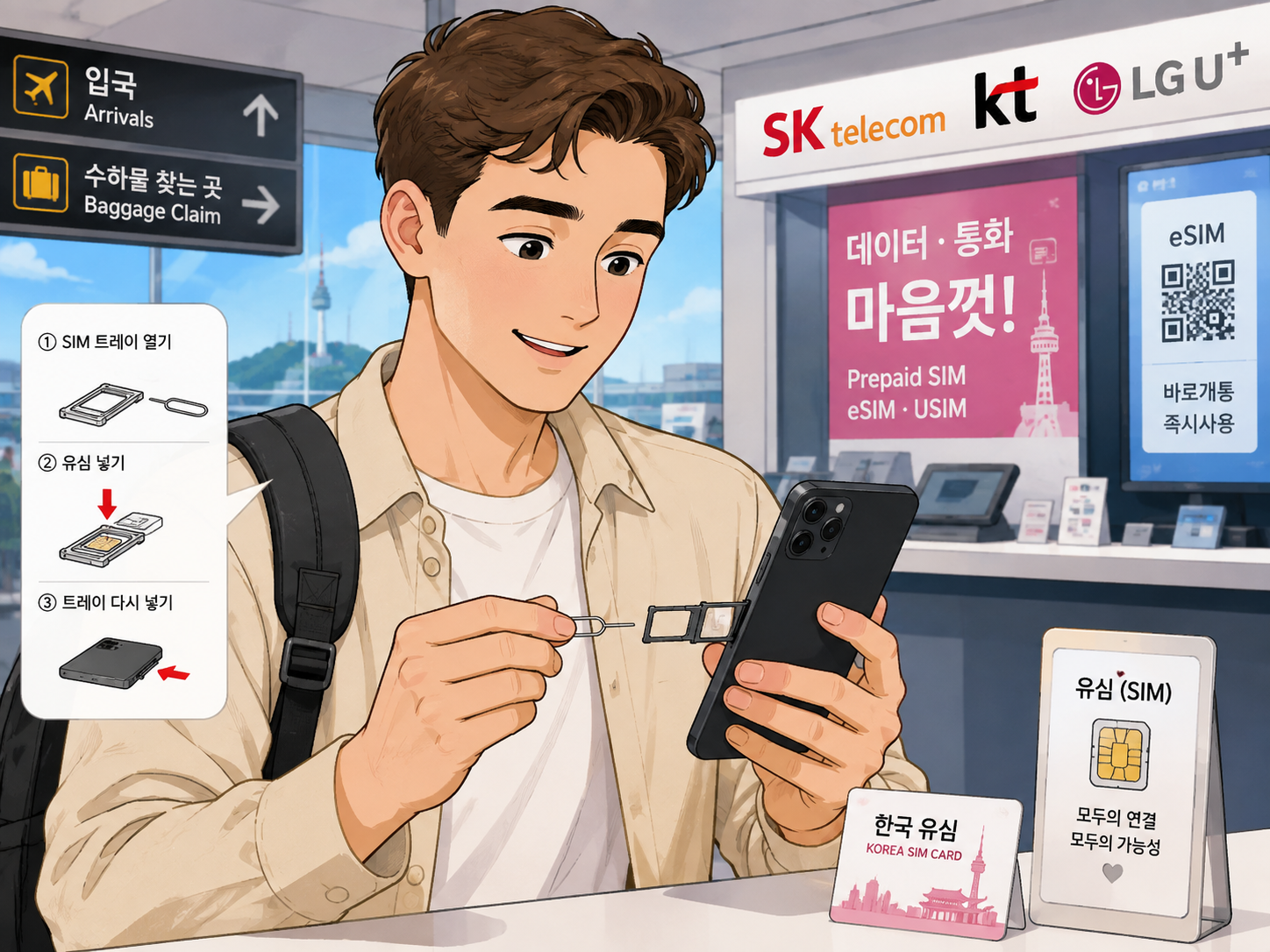
Getting mobile service is one of the first things most foreigners need after arriving in Korea. At first, the choice sounds simple: physical SIM or eSIM. But if you are actually moving to Korea, there is a more important question.
Do you only need mobile data for maps and messages, or do you need a Korean phone number that can later work with Korean identity-verification systems? Those are not always the same thing.
The short version
| Your situation | Best starting point | What to check |
|---|---|---|
| Short tourist trip | Tourist eSIM or SIM | Data amount, calls/SMS, eSIM compatibility. |
| Moving to Korea without Residence Card yet | Passport-based prepaid SIM | Validity period, top-up rules, Korean 010 number. |
| Long-term resident | Resident mobile line | Legal-name registration and identity-verification support. |
| Banking, PASS, resident services | Verified line in your own name | Ask directly whether mobile identity verification works for foreign residents. |
The key distinction is:
Internet access is not the same as a Korean phone number. A Korean phone number is not automatically the same as Korean mobile identity verification.
1. SIM vs eSIM
A physical SIM is the small chip you insert into your phone. An eSIM is a digital SIM profile installed on a compatible device. Both can provide mobile data, and some plans also include voice calls and SMS.
The main advantage of an eSIM is convenience. You can often buy it online, receive a QR code or activation instructions, and install it without visiting a store. The downside is that not every phone supports eSIM, and not every eSIM includes a Korean number.
2. Check your phone before buying
Before purchasing an eSIM or SIM plan, check four things:
- Your exact phone model supports eSIM if you want a digital plan.
- Your device is unlocked and not restricted to your home carrier.
- Your phone can connect to Korean mobile networks.
- You understand when the plan starts counting its validity period.
Some travel plans begin when installed, while others begin when first connected in Korea. Read the activation rule before scanning a QR code.
3. Three phone setups foreigners should understand
Type A: tourist SIM or eSIM
This is best for tourists and short stays. It usually solves maps, messaging, translation and social media quickly. For a two-week trip, that may be all you need.
Type B: passport-based prepaid Korean line
This can be useful for newly arrived students, workers or long-stay visitors who are waiting for a Residence Card. Official carrier guidance shows that prepaid service can often be opened with a valid passport, but passport-based service may have time limits and later verification steps.
Type C: long-term resident mobile line
This is the setup many residents eventually need for banking, Korean online services, PASS and other mobile identity-verification systems. The important point is not only whether the number starts with 010. It is whether the line is correctly registered in your own legal name and identity data.
4. Tourist SIM or eSIM
Tourist products are the easiest option for short-term visitors. Major Korean carriers sell visitor SIM and eSIM products, and pickup counters are common at major airports. VISITKOREA also explains that prepaid SIM and eSIM products for visitors are available through carriers, airports, online sellers and some convenience-store channels.
For tourism, focus on practical details:
- How many days the plan lasts.
- Whether it is data-only or includes calls and SMS.
- Whether it gives you a Korean 010 number.
- Whether you can top it up or extend it.
- Whether airport pickup is available when you arrive.
5. Data-only eSIM vs data + voice
Read the product details carefully. Some eSIMs provide only mobile data. Others include voice calls, SMS and a Korean 010 number. This matters because a data-only eSIM may be fine for NAVER Map, Papago, KakaoTalk and email, but it may not help when a restaurant, taxi driver, delivery driver or reservation system expects a local phone number.
6. Why a Korean 010 number matters
Korean mobile numbers commonly begin with 010. A Korean number is useful for:
- Taxi drivers and delivery drivers.
- Restaurant waiting lists.
- Local reservations and callbacks.
- SMS notices from stores, schools or services.
- Communicating with landlords, workplaces or classmates.
If you are only visiting Korea, you may be fine with data and app-based calls. If you are living in Korea, voice and SMS capability becomes much more useful.
7. A Korean number is not automatically identity verification
This is one of the most important points in this guide. Having a Korean number like
010-xxxx-xxxx does not automatically mean you can pass every screen that asks
for 본인인증 or 휴대폰 본인확인.
Korean mobile identity verification connects the phone line, the carrier record and your legal identity data. A tourist line or passport-only prepaid line may be useful for calls, texts and data, but still not work like a fully verified resident line.
So do not ask only, "Does this plan have a Korean number?" Ask whether it supports mobile identity verification for a registered foreign resident.
8. Passport-based prepaid service can be a bridge
If you arrive for university, employment, language study, working holiday or another long stay, your Residence Card may not be ready immediately. A prepaid line opened with a passport can keep you connected during the waiting period.
Official carrier information from SK Telecom and KT indicates that prepaid service can be opened by foreigners with a valid passport. KT's foreigner prepaid guidance also distinguishes passport-based use from service connected to foreigner-registration credentials, and states that prepaid service activated with a passport is available for 90 days from activation before additional resident or real-name verification becomes relevant.
9. Treat passport prepaid as temporary
A passport-based prepaid SIM can be very helpful, but do not treat it as your permanent resident setup. Once your Residence Card arrives, visit your carrier and ask whether the line should be updated to your resident identity information.
This matters for future services such as banking, account recovery, delivery apps, online shopping, government services and PASS. It is easier to fix your phone identity early than to discover a mismatch after you need an urgent verification code.
10. Do not use a line under someone else's name
Newcomers sometimes think it is easier to ask a Korean friend, partner or coworker to open a phone line for them. Avoid this for long-term life.
A phone line registered under another person's name can create problems with mobile identity verification, banking, account recovery and responsibility for the line. Your long-term Korean phone should be registered in your own legal name.
11. Long-term mobile service after your Residence Card
After receiving your Residence Card, your options usually improve. A resident mobile setup is where you should ask about:
- Prepaid vs postpaid plans.
- Your legal name exactly as registered in Korea.
- Whether the plan supports mobile identity verification.
- Whether PASS can be used.
- How billing and payment will work.
- Whether you can keep or change your number later.
12. Prepaid vs postpaid
| Plan type | How it works | Best for |
|---|---|---|
| Prepaid | You pay before using service. | Tourists, short stays, newcomers waiting for documents. |
| Postpaid | You use service first and pay through monthly billing. | Many long-term residents, employees and students. |
Do not assume prepaid is always bad or postpaid is always better. The more important question is whether your line is correctly registered to your resident identity and works with the services you need.
13. PASS and mobile identity verification
PASS is widely used in Korea for mobile authentication and identity-verification flows. If PASS is important for your life in Korea, ask your carrier directly:
Does this plan support mobile identity verification for foreign residents?
A staff member may understand this better if you show the Korean phrase 외국인 본인인증. Do not rely on a vague promise that the plan has a Korean phone number.
14. Name matching is extremely important
Korean services may compare your Residence Card, mobile carrier record, bank account and online-service account. Problems can happen if one system uses:
JOHN MICHAEL SMITHJOHN SMITHSMITH JOHN MICHAEL
Use your official registered name consistently. When you open or update a line, ask staff to match your Residence Card record as closely as possible.
15. Should you buy a SIM at Incheon Airport?
For short-term visitors, airport purchase is convenient. It gives you immediate data, help at a counter and a chance to test the SIM before leaving the terminal.
For long-term residents, the airport does not need to solve everything. You can use an airport SIM or eSIM as a temporary connection, settle into your accommodation, then review your resident phone setup after your Residence Card is ready.
16. Major Korean mobile networks
Korea's three major mobile-network operators are SK Telecom, KT and LG U+. There are also MVNO and budget-carrier options. Budget carriers can be cheaper, but support, store access, English guidance and verification compatibility can vary.
If you are new to Korea and do not speak Korean, paying slightly more for easier support can sometimes be worth it during your first months.
17. Keep your home-country SIM if possible
If your phone supports dual SIM or eSIM plus physical SIM, it can be useful to keep your original number active for foreign banking codes, WhatsApp, account recovery and family contacts. Just be careful with international roaming charges.
After arriving, check your phone settings so mobile data uses your Korean line, not expensive home-carrier roaming.
18. Questions to ask at the store
| Korean | Pronunciation | Meaning |
|---|---|---|
| 이 요금제는 외국인 본인인증이 돼요? | i yogeumjeneun oegugin bonin-injeungi dwaeyo? | Does this plan support identity verification for foreigners? |
| 제 명의로 개통되는 거예요? | je myeonguiro gaetongdoeneun geoyeyo? | Will this be registered in my name? |
| PASS 사용할 수 있어요? | PASS sayonghal su isseoyo? | Can I use PASS? |
| 010 번호가 나와요? | gong-il-gong beonhoga nawayo? | Do I get a 010 number? |
| 외국인등록증 나오면 정보 변경할 수 있어요? | oegugin-deungnokjeung naomyeon jeongbo byeongyeonghal su isseoyo? | Can I update my information after I receive my Residence Card? |
19. Useful Korean phone words
| Korean | Meaning |
|---|---|
| 유심 | SIM card |
| 이심 / eSIM | eSIM |
| 개통 | Activation |
| 선불 | Prepaid |
| 후불 | Postpaid |
| 요금제 | Mobile plan |
| 데이터 | Data |
| 무제한 | Unlimited |
| 통화 | Voice call |
| 문자 | Text message |
| 휴대폰 번호 | Mobile number |
| 본인인증 | Identity verification |
| 명의 | Registered account name |
| 충전 | Top-up |
| 해지 | Cancel service |
| 약정 | Contract commitment |
| 통신사 | Mobile carrier |
| 외국인등록증 | Residence Card |
| 여권 | Passport |
20. Useful Korean phrases
| English | Korean | Pronunciation |
|---|---|---|
| I need a SIM card. | 유심이 필요해요. | yusimi piryohaeyo |
| I want a prepaid plan. | 선불 요금제로 하고 싶어요. | seonbul yogeumjero hago sipeoyo |
| I only have my passport. | 지금 여권만 있어요. | jigeum yeogwonman isseoyo |
| I do not have my Residence Card yet. | 아직 외국인등록증이 없어요. | ajik oegugin-deungnokjeungi eopseoyo |
| Does this include calls and texts? | 통화하고 문자도 포함돼요? | tonghwahago munjado poham dwaeyo? |
| Is this data only? | 데이터 전용이에요? | deiteo jeonyongieyo? |
| Can I use identity verification? | 본인인증할 수 있어요? | bonin-injeunghal su isseoyo? |
Common mistakes
- Buying a data-only eSIM without realizing calls and SMS are not included.
- Assuming every Korean 010 number supports 본인인증.
- Choosing a permanent plan at the airport while exhausted.
- Registering a line under someone else's name.
- Using different English names across phone, bank and resident records.
- Forgetting to update carrier information after receiving a Residence Card.
- Accidentally using expensive home-country data roaming.
Newcomer setup timeline
| Timing | What to do |
|---|---|
| Before your flight | Check phone unlock status, eSIM support and whether you need data only or calls/SMS. |
| Arrival day | Activate temporary SIM/eSIM, test data, install NAVER Map and KakaoTalk. |
| First week | Use temporary service while starting your Residence Card process. |
| After Residence Card | Visit a carrier, update your identity information and ask about 본인인증 and PASS. |
FAQ
Can foreigners buy a SIM in Korea with only a passport?
Yes. Major carriers offer prepaid options that can often be opened with a valid passport. Requirements can change, so check the carrier's current visitor or foreigner guidance before choosing.
Can I get a postpaid phone plan with only a passport?
Normal long-term postpaid service usually requires stronger resident identification. A passport-only setup is more commonly used for prepaid or visitor products.
Does having a 010 number mean I can use PASS?
Not necessarily. PASS and other identity-verification flows depend on whether the mobile line and identity data are eligible for mobile verification.
Should I choose eSIM or a physical SIM?
For short-term convenience, eSIM is excellent if your phone supports it. For long-term residents, registration and identity-verification compatibility matter more than whether the SIM is physical or digital.
Can I keep my foreign SIM while using a Korean eSIM?
If your phone supports dual SIM or eSIM plus physical SIM, generally yes. Check data-roaming settings carefully so your home line does not create unexpected charges.
Final advice
Do not choose a Korean phone plan based only on how many gigabytes it includes. For a tourist, that may be enough. For someone starting life in Korea, ask what you will need this phone number to do three months from now.
A practical newcomer strategy is temporary SIM or eSIM on arrival, Residence Card setup, then a properly registered long-term Korean mobile line if your life in Korea requires banking, PASS, resident services or mobile identity verification.
Related KoreaVibes guides
- First Week in Korea: What Foreigners Should Set Up First
- Essential Korean Apps for Newcomers Living in Korea
- T-money Card Guide for Foreign Visitors
- How to Pay in Korea as a Foreigner
- How to Take a Taxi in Korea as a Foreigner
Coming next in Start Here
- How to Use Korean Convenience Stores: Food, Payments, Delivery Pickup and Daily Basics
- How to Get a Residence Card in Korea
- PASS App and Korean Phone Verification Explained
- How to Open a Bank Account in Korea as a Foreigner