
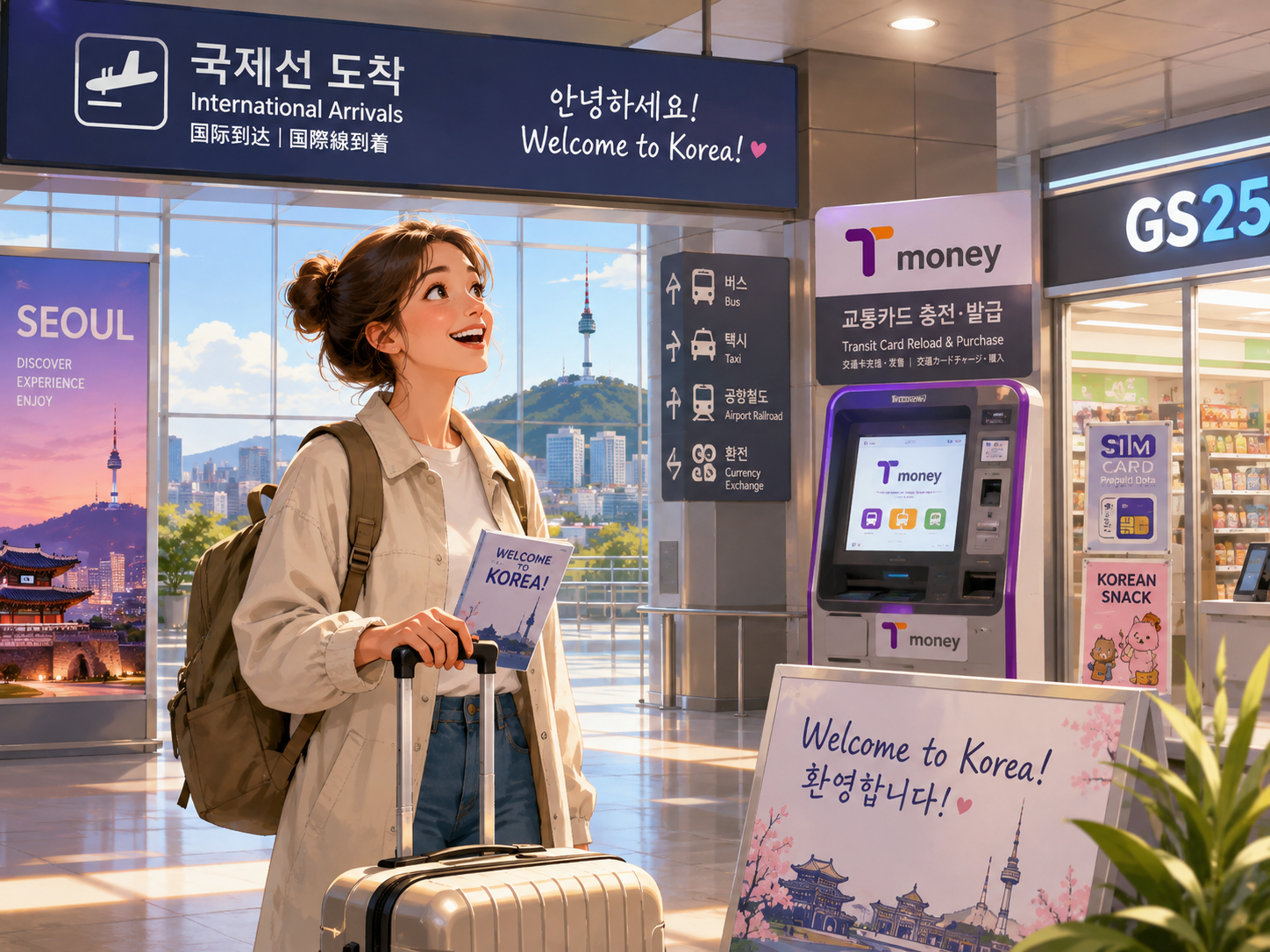
Moving to Korea is exciting, but the first few days can also feel surprisingly complicated. You may have a place to stay and a suitcase unpacked, but everyday life quickly brings new questions: how to get a Korean phone number, which map app to use, how to pay for the subway, whether you need a Residence Card, and why Korean websites keep asking for identity verification.
You do not need to solve everything on your first day. The easiest way to start life in Korea is to set up a few basic systems in the right order.
The short version
- Make sure your address and immigration plans are in order.
- Get mobile data and, if possible, a Korean phone number.
- Install NAVER Map, Papago, KakaoTalk and essential Korean apps.
- Get a transportation card for buses and subways.
- Learn how everyday payments work with cards, cash and kiosks.
- Start your Residence Card process if you will stay long-term.
- Prepare for a Korean bank account, but do not panic if it cannot happen immediately.
- Save emergency and foreigner-help numbers.
- Learn your full Korean address.
- Accept that some Korean online services may not work until your identity setup is complete.
For many long-term newcomers, life becomes much easier once two things are in place: a Residence Card and a Korean mobile number registered in your own name.
1. First, know whether you are a visitor or a resident
Not every foreigner arriving in Korea needs the same setup. A two-week visitor and a long-term resident have different priorities. If you are moving for university, work, working holiday, family, long-term study or another long-term visa, your first week should include immigration planning.
If you intend to stay in Korea for more than 90 days, foreigner registration is generally required, subject to your visa status and any applicable exemptions. The Ministry of Justice explains that foreigners who intend to stay more than 90 days should register within 90 days of entry. That registration leads to the Korean Residence Card, often still informally called an ARC because the previous English name was Alien Registration Card.
2. Do not wait until day 89 to think about your Residence Card
If you are a long-term resident, start checking the process during your first week. You may need to reserve an immigration appointment, confirm which immigration office has jurisdiction over your address, prepare proof of residence, prepare a passport photo and collect visa-specific documents.
Do not assume everyone needs exactly the same paperwork. Your visa category matters. If you are uncertain, call the Immigration Contact Center at 1345, which provides immigration and living-in-Korea information in multiple languages.
3. Your Residence Card unlocks more of Korea
At first, you may wonder why so many services ask whether you have your Residence Card. It can become important for mobile-phone subscriptions, bank services, online identity verification, government services, insurance and employment administration.
Since 2025, eligible registered foreign residents have also been able to obtain a mobile Residence Card for use at participating public institutions, financial institutions, convenience stores and hospitals. You do not necessarily need the mobile version during your first week. The physical Residence Card process is the priority.
4. Get mobile data immediately
Your phone will probably be the most important tool you have during your first week. You will use it for maps, translation, subway directions, taxi apps, landlord messages, banking later, delivery, reservations and immigration information.
If you arrive without Korean mobile service, a temporary prepaid SIM or eSIM is perfectly reasonable. Major Korean carriers provide foreigner-oriented products, and some options can be picked up at the airport.
5. A tourist eSIM and a Korean phone number are not always the same thing
A data-only travel eSIM may give you excellent internet access but no usable Korean phone number. That may be fine for your first few days, but if you will live in Korea, you will eventually want a Korean number because phone numbers are widely used for delivery calls, restaurant waiting lists, account registration, reservations, identity verification, banking and payment services.
When choosing your first SIM or eSIM, check whether it includes data, voice calls, SMS and a Korean 010 phone number. Do not choose based only on the amount of data.
6. Keep your English name consistent
When setting up mobile service, your Residence Card, bank account and online accounts, try to keep the English spelling and spacing of your name consistent with your official documents. A small difference in spelling, order or spacing can cause unnecessary verification problems later.
7. Install NAVER Map before you start exploring
For everyday navigation in Korea, install NAVER Map early. You will use it for subway routes, bus routes, walking directions, building entrances, restaurants, clinics, opening hours and addresses. Google Maps can still help with general reference and international reviews, but it should not be your only navigation tool in Korea. KakaoMap is also a useful backup.
A simple setup is: NAVER Map first, KakaoMap second, Google Maps for general reference.
8. Install a translation app
Even if you are studying Korean, you will immediately encounter things you have never learned in a textbook: delivery messages, building notices, restaurant menus, banking screens, appliance buttons and pharmacy labels. Papago is particularly useful for Korean, and Google Translate can be a helpful secondary app.
9. Start with a small core of apps
Do not install 40 Korean apps on your first day. Start with a small core and add more as your phone number, Residence Card and payment setup become stable.
| Need | Useful apps | First-week note |
|---|---|---|
| Navigation | NAVER Map, KakaoMap | Use NAVER Map as your main local map. |
| Translation | Papago, Google Translate | Keep both available for menus, messages and signs. |
| Taxi | Kakao T, k.ride | Some payment or verification features may depend on your setup. |
| Messaging | KakaoTalk | Important for friends, schools, workplaces and groups. |
| Shopping later | Coupang and other commerce apps | May be easier after Korean phone verification and payment setup. |
10. Get a transportation card
If you expect to use public transport regularly, get a transportation card quickly. The standard option for most newcomers is T-money. Transportation cards can be used for buses and subways and are widely available through convenience stores and transportation facilities.
Once you have one, remember: tap when entering, and on buses and many transit journeys, tap again when leaving. For the full setup, read the T-money Card Guide for Foreign Visitors.
11. Should you get a Climate Card?
If you live in Seoul and use public transportation frequently, you may hear about the Climate Card. Do not automatically buy one on your first day. Whether it is worthwhile depends on where you live, which subway lines and buses you use, how often you travel and the current official rules.
For your first few days, a normal transportation card is simpler.
12. Learn how Korean payments work
Korea is highly card-oriented, but newcomers can still run into problems. A foreign card may work at one place and fail at another. During your first week, keep at least one main international card, one backup card and some Korean won in cash.
Do not depend entirely on one card. For a deeper overview, read How to Pay in Korea as a Foreigner.
13. You probably do not need a Korean bank account on day one
Many newcomers panic about opening a Korean bank account immediately. Usually, you can spend the first few days settling in first. Bank-account opening rules vary by bank, branch, immigration status, purpose of the account and documents available.
If your Residence Card has not arrived, do not be surprised if your banking options are more limited. If you came for university, language school, employment or research, ask whether your organization works with a particular bank. A campus or employer-linked branch may be easier than a random branch.
14. Learn your full Korean address
Save your address in both English and Korean. You will need it for immigration, taxi rides, food delivery, online shopping, bank documents, hospital forms and packages. A Korean address may include a road name, building number, building name, floor and unit number.
Create a note in your phone with your Korean address, English address, building name, unit number, nearest subway station and a NAVER Map pin for home.
15. Learn your building before you learn the whole neighborhood
Korean apartments, officetels and villas can be confusing at first. During your first week, figure out the main entrance, door code or key, parcel area, trash area, recycling area, elevator, parking entrance and building manager or landlord contact. Take photos of instructions if necessary. You will understand them later.
16. Ask how trash works before throwing anything away
Do not assume Korea uses the same trash system as your home country. Waste rules can vary by local government and building, but commonly involve separate systems for general waste, food waste, recycling and large items. Ask your landlord, building manager, dormitory office or neighbor during your first week.
Do not leave a random garbage bag outside your building.
17. Find your nearest convenience store
A Korean convenience store can solve many first-week problems. You can usually find water, food, toiletries, batteries, umbrellas, basic household items, transportation cards, ATM access in some locations and parcel-related services at participating stores.
Find the nearest CU, GS25, 7-Eleven or Emart24 to your home. You will probably use it often.
18. Find a pharmacy before you need one
Search NAVER Map for 약국, which means pharmacy. Save one close to home, work or university. Korean pharmacies are common, but opening hours vary. Knowing where one is before you are sick is much easier than searching with a fever.
19. Find a clinic or hospital near your home
You do not need to register with one immediately, but save nearby options. A small neighborhood clinic may be more practical for many everyday health problems than going directly to a major university hospital.
| Korean | Meaning | When to search it |
|---|---|---|
| 내과 | Internal medicine | Colds, stomach issues and general symptoms. |
| 이비인후과 | ENT | Throat, nose, ear, sinus and cold-like symptoms. |
| 피부과 | Dermatology | Skin problems and dermatology care. |
| 치과 | Dentist | Teeth, gums and dental emergencies. |
| 안과 | Ophthalmology | Eye problems, contact-lens issues and vision care. |
20. Save emergency and help numbers
| Number | Use | Note |
|---|---|---|
| 112 | Police | Use for police emergencies. |
| 119 | Fire / ambulance | Use for fire and emergency rescue. |
| 1345 | Immigration Contact Center | Immigration and living-in-Korea information in multiple languages. |
| 1330 | Korea Travel Helpline | Travel information and interpretation support. |
If you live in Seoul, also know about the Seoul Global Center, which provides support for foreign residents on immigration, daily-life problems, labor, finance, tax questions and other local issues.
21. Do not try to set up every Korean service immediately
A common newcomer mistake is trying to create every Korean account at once: Coupang, Baemin, Yogiyo, banks, membership apps and government portals. Then something asks for a Korean phone verification, Residence Card number or Korean payment method.
Some services are easier after your long-term phone number and Residence Card are properly connected. Your first week is about creating the foundation.
22. Understand Korean phone verification
You will soon encounter 본인인증, which means identity verification. A website may ask you to verify your name, date of birth, mobile carrier, phone number and resident identification information. Having a Korean number alone does not necessarily mean every type of identity verification will work.
This is why setting up your long-term phone service correctly after receiving your Residence Card matters.
23. Keep important documents organized
During your first weeks, you may repeatedly need your passport, visa information, housing contract, proof of residence, employment contract, university documents and passport photograph. Keep them organized, but treat passport and identity-document images carefully because they contain sensitive personal information.
A realistic first-week setup
| Timing | What to do |
|---|---|
| Day 1 | Connect mobile data, reach accommodation, save your address, install NAVER Map, get cash, buy a transportation card, find a convenience store. |
| Day 2 | Set up or confirm your Korean phone number, install Papago and KakaoTalk, learn your commute, locate trash and recycling areas. |
| Day 3 | Check Residence Card requirements, make an immigration reservation if necessary, gather documents, ask your school or employer about support. |
| Day 4 | Find your nearest pharmacy and clinic, save emergency numbers, learn building and delivery instructions. |
| Day 5 | Ask about a bank account, compare bank options and confirm whether you need your Residence Card first. |
| Weekend | Practice buses and subways, explore your neighborhood, visit a supermarket and make sure you can get home without relying on one app. |
What can wait until week two or later?
You probably do not need to complete everything immediately. Korean credit cards, full food-delivery setup, Coupang membership, PASS app, mobile Residence Card, Korean driver's license, advanced banking, utility autopay and long-term insurance administration can usually wait until your basic identity, phone and banking setup is more stable.
Useful Korean words for your first week
| Korean | Romanization | Meaning |
|---|---|---|
| 외국인 | oegugin | Foreigner |
| 외국인등록 | oegugin deungnok | Foreigner registration |
| 체류지 | cheryuji | Place of residence |
| 주소 | juso | Address |
| 휴대폰 | hyudaepon | Mobile phone |
| 유심 | yusim | SIM card |
| 본인인증 | bonin injeung | Identity verification |
| 은행 | eunhaeng | Bank |
| 계좌 | gyejwa | Bank account |
| 교통카드 | gyotong kadeu | Transportation card |
| 약국 | yakguk | Pharmacy |
| 병원 | byeongwon | Hospital / clinic |
| 쓰레기 | sseuregi | Trash |
| 분리수거 | bunri sugeo | Recycling separation |
| 택배 | taekbae | Parcel / delivery |
Useful Korean phrases
| Korean | Romanization | Meaning |
|---|---|---|
| 한국에 막 이사 왔어요. | Hanguge mak isa wasseoyo. | I just moved to Korea. |
| 외국인이에요. | Oeguginieyo. | I am a foreigner. |
| 유심은 어디서 살 수 있어요? | Yusimeun eodiseo sal su isseoyo? | Where can I get a SIM card? |
| 교통카드는 어디서 살 수 있어요? | Gyotongkadeuneun eodiseo sal su isseoyo? | Where can I get a transportation card? |
| 쓰레기는 어디에 버려요? | Sseuregineun eodie beoryeoyo? | Where do I throw away trash? |
| 약국이 어디예요? | Yakgugi eodiyeyo? | Where is the pharmacy? |
| 은행 계좌를 만들 수 있어요? | Eunhaeng gyejwareul mandeul su isseoyo? | Can I open a bank account? |
| 한국어를 잘 못해요. | Hangugeoreul jal mothaeyo. | I do not speak Korean well. |
Common first-week mistakes
- Trying to do everything on day one.
- Choosing a data-only eSIM without realizing it has no Korean phone number.
- Waiting too long to check immigration requirements.
- Using only Google Maps instead of installing NAVER Map.
- Using different versions of your name across documents and accounts.
- Throwing trash away without checking the local system.
- Assuming a foreign card will always work.
- Opening every Korean app before you can pass phone verification.
First-week checklist
- Save my Korean home address.
- Get mobile data.
- Get or plan for a Korean phone number.
- Install NAVER Map, Papago and KakaoTalk.
- Get a transportation card.
- Check Residence Card requirements.
- Book an immigration appointment if required.
- Organize passport and housing documents.
- Find my trash and recycling area.
- Find the nearest convenience store, pharmacy and clinic.
- Save 112, 119, 1345 and 1330.
- Ask my school or employer about banking support.
FAQ
Do I need a Residence Card immediately after arriving?
If you intend to stay more than 90 days and are subject to foreigner registration, registration should generally be completed within 90 days of entry. Start preparing early rather than waiting until the deadline.
Can I get a Korean SIM without a Residence Card?
Yes, prepaid options can be easier at the beginning and may be available with a passport. Long-term phone plans and full identity verification may require more documentation.
Should I get a bank account during my first week?
You can investigate your options, but many newcomers find the process easier after receiving their Residence Card. Requirements vary by bank and branch.
Which map app should I use?
NAVER Map should be your primary local navigation app, with KakaoMap as a useful backup and Google Maps for general reference.
What number should I call about my visa or Residence Card?
Call the Immigration Contact Center at 1345.
Final advice
Your first week in Korea is not about becoming fully integrated into every Korean system. It is about building the foundation: identity, phone, navigation, transportation, address and banking. Once your Residence Card and long-term Korean phone number are properly set up, many other services become easier.
Do not worry if you cannot immediately use every delivery app, banking function or Korean website. Get the basics right first. A month from now, things that feel confusing today will probably feel ordinary.
Related KoreaVibes guides
- How to get from Incheon Airport to Seoul
- T-money Card Guide for Foreign Visitors
- How to Pay in Korea as a Foreigner
- How to use the Seoul subway as a foreign visitor
- How to Use a Korean Restaurant Kiosk
- How to Take a Taxi in Korea as a Foreigner
Coming next in Start Here
- Essential Korean Apps for Newcomers Living in Korea
- How to Get a SIM Card or eSIM in Korea as a Foreigner
- How to Open a Bank Account in Korea as a Foreigner
- ARC / Residence Card Guide for Foreigners in Korea
- PASS App and Korean Phone Verification Explained
- How Korean Addresses Work
- How Trash and Recycling Work in Korea
- How to Visit a Pharmacy in Korea
- How to Go to a Hospital or Clinic in Korea